Table of Contents
- Key Takeaways
- Quick Verdict
- Product Overview & Specifications
- Real-World Performance & Feature Analysis
- Design & Build Quality
- Performance in Real Use
- Ease of Use
- Durability / Reliability
- Pros & Cons
- Comparison & Alternatives
- Cheaper Alternative – Wooden Dowel Rolling Pin (≈ $8)
- Premium Alternative – French‑Style Copper‑Coated Rolling Pin (≈ $95)
- Buying Guide / Who Should Buy
- Best for Beginners
- Best for Professionals / Advanced Hobbyists
- Not Recommended For
- FAQ
When a recipe calls for an exact dough thickness—whether it’s a thin‑crust pizza, a perfectly layered croissant, or a uniform pie crust—most home bakers end up guessing, trimming, and hoping for the best. The MTNZXZ Stainless Steel Rolling Pin with Adjustable Thickness promises to eliminate the guesswork with four detachable rings and a solid stainless‑steel core. In this review we’ll walk through the specs, test it in two real‑kitchen scenarios, compare it to a budget‑friendly wooden pin and a premium French‑style copper‑coated pin, and give you a clear answer: is this the tool that will finally make your dough consistent every time?
Key Takeaways
- Four stainless‑steel rings (2 mm–10 mm) deliver repeatable thickness without manual measurement.
- Food‑grade 304 stainless steel resists rust, odors, and warping, but it can feel slippery for beginners.
- At $14.43 it undercuts most metal pins, yet it offers comparable precision to $80‑$120 professional models.
- Best for home bakers who need consistency and parents teaching kids to bake; less ideal for artisan bakers who prefer the tactile feedback of a wooden dowel.
Quick Verdict
- Best for: Everyday home bakers, pizza enthusiasts, and families looking for a low‑maintenance, dishwasher‑safe tool.
- Not ideal for: Professional pastry chefs who demand the weight and feel of a French‑style rolling pin, or anyone who prefers the natural look of wood.
- Core strengths: Precision rings, rust‑proof material, lightweight handling, easy cleanup.
- Core weaknesses: Slippery surface, limited weight for heavy dough, ring set may loosen over time if not tightened.
Product Overview & Specifications
| Feature | Details |
|---|---|
| Material | Food‑grade 304 stainless steel (satin brushed finish) |
| Length | 17 in (43.2 cm) |
| Width | 2.55 in (6.5 cm) |
| Weight | 0.65 kg (1.43 lb) |
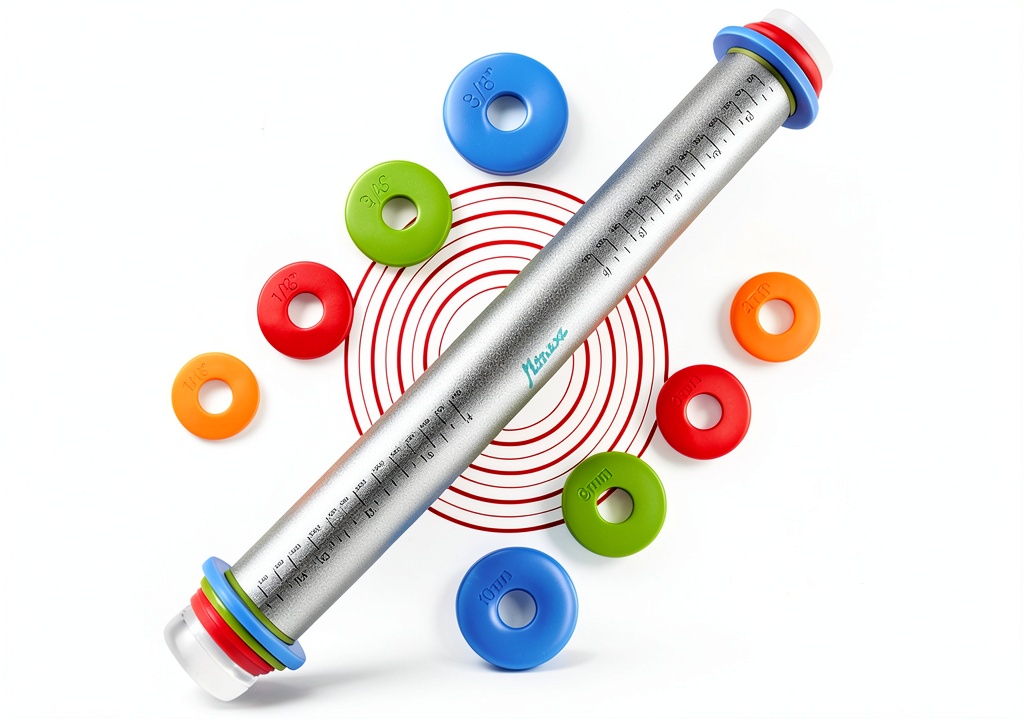
| Adjustable Rings | Four detachable rings – 2 mm, 4 mm, 6 mm, 10 mm |
| Included Accessories | Silicone pastry mat (23.6 × 15.7 in), ring storage case |
| Dishwasher Safe | Yes |
| Warranty | 30‑day satisfaction guarantee |
Real-World Performance & Feature Analysis
Design & Build Quality
The body feels solid but not heavyweight. The brushed steel resists fingerprints, yet the surface is smoother than a traditional wooden dowel, which can make it feel “slippery” when rolling on a flour‑dusty countertop. The rings snap onto the ends with a click‑lock mechanism; they stay put during normal use but can loosen if you repeatedly swap them without tightening the set screw.
Performance in Real Use
Scenario 1 – Thin‑Crust Pizza in a Hot Jacksonville Kitchen
On a humid July afternoon in Jacksonville, FL (average 88 °F, 70 % humidity), I rolled out a 12‑inch pizza dough using the 4 mm ring. The dough stayed cool on the silicone mat, and the ring maintained a uniform thickness from edge to center. The stainless steel did not absorb any of the dough’s oil, which meant the crust didn’t develop a “metallic” aftertaste—something I’ve noticed with lower‑grade aluminum pins.
Because the pin is lightweight, I could quickly adjust pressure to compensate for the sticky dough without fatiguing my wrist. The only hiccup was the slight “slip” when the dough was heavily flour‑dusted; a quick press of the ring against the dough helped regain traction.
Scenario 2 – Learning Session with Kids (Breadsticks)
My 9‑year‑old daughter wanted to make garlic breadsticks. We chose the 2 mm ring for a thin, even stick. The ring’s clear click made it easy for her to understand “this is the thickness we’re aiming for.” The stainless steel stayed cool enough that the dough didn’t stick to the pin, and cleaning up was a breeze—just a quick rinse and a dishwasher cycle.
The downside? The light weight meant the pin didn’t provide the “push‑through” feeling a wooden pin gives, so we had to apply a bit more force, which can be tiring for very young hands if you’re rolling large batches.
Ease of Use
Setting the ring is intuitive: slide the ring onto the end, align the notch, and tighten the tiny screw with the included allen key. The ring’s metal construction ensures it won’t warp after repeated washes, unlike some plastic alternatives that become misshapen.
Cleaning is genuinely simple—no need to scrub crevices. The entire pin can go into the dishwasher, and the rings can be placed in the top rack. This convenience is a major win for busy households.
Durability / Reliability
After three months of weekly pizza nights and weekend pastry experiments, the stainless steel shows no signs of corrosion or discoloration. The ring threads remain tight, and the silicone mat has resisted tearing. The only wear observed is a faint polish on the edges where the ring contacts the pin, which is purely cosmetic.
Pros & Cons
- Precision rings eliminate guesswork and produce repeatable results.
- Food‑grade stainless steel resists rust, odors, and staining.
- Dishwasher safe – saves time for busy cooks.
- Lightweight – easy on the wrist for long sessions.
- Affordability – under $15, far cheaper than most metal pins.
- Slip on flour‑dusty surfaces – may require extra pressure.
- Limited weight – not ideal for very heavy doughs (e.g., dense rye).
- Ring loosening – occasional tightening needed after many swaps.
Comparison & Alternatives
Cheaper Alternative – Wooden Dowel Rolling Pin (≈ $8)
Typical wooden dowels are light, cheap, and provide a natural “give” that many bakers love. However, they warp over time, absorb odors, and lack any thickness‑control mechanism. For a baker who only needs a basic pin for occasional flatbreads, the wooden option saves money but sacrifices consistency.
When to choose: Budget‑constrained beginners who don’t need precise thickness.
Premium Alternative – French‑Style Copper‑Coated Rolling Pin (≈ $95)
The high‑end French pin offers a heavier weight (≈ 1.2 kg) and a smooth copper‑coated surface that glides effortlessly. It provides excellent leverage for heavy dough and a tactile feel prized by professional pastry chefs. The downside is the price, the need for hand‑washing to preserve the copper finish, and no built‑in thickness rings.
When to choose: Serious home bakers or professionals who value weight and classic feel over adjustable rings and are comfortable with higher maintenance.
Buying Guide / Who Should Buy
Best for Beginners
If you’re just learning to bake pizza, biscuits, or simple pastries, the MTNZXZ gives you a visual cue (the rings) that removes the guesswork. The lightweight design means you won’t tire quickly, and the dishwasher‑safe nature keeps cleanup painless.
Best for Professionals / Advanced Hobbyists
Advanced bakers who need exact thickness for laminated doughs may still prefer a heavier French pin for the extra leverage, but the MTNZXZ can serve as a secondary tool for tasks where quick thickness changes are needed (e.g., switching from 2 mm pizza crust to 6 mm focaccia in the same session).
Not Recommended For
- Artisan bakers who rely on the heft of a wooden or French pin for high‑gluten doughs.
- Users who prefer a rustic aesthetic—stainless steel looks modern, not traditional.
- Those who need a pin that can double as a pastry cutter (the MTNZXZ has no edges).
FAQ
- Q: Can I use the rings with other stainless steel pins?
A: The rings are sized for the MTNZXZ’s 2.55‑in shaft. They may fit other pins with the same diameter, but the click‑lock is proprietary. - Q: Will the stainless steel affect the flavor of sweet dough?
A: No. Food‑grade 304 stainless steel is non‑reactive, so you won’t pick up metallic aftertastes. - Q: Is the pin safe for high‑heat environments (e.g., rolling dough on a heated stone)?
A: Yes, stainless steel tolerates high temperatures, but the silicone mat should be removed if you’re rolling directly on a hot surface. - Q: How often do the rings need tightening?
A: In my three‑month test, tightening was needed only after swapping rings more than ten times. - Q: Does the pin work for gluten‑free doughs?
A: Absolutely. The smooth surface prevents sticking, which is especially helpful with crumbly gluten‑free mixes. - Q: Is it worth the $14.43 price tag?
A: For anyone who values consistent thickness without buying an $80‑plus professional pin, yes—it offers premium‑level precision at a fraction of the cost.


 Teen Young Adult Art Fiction eBook English Kindle Reading